Claude Code in Slack Validates What We've Been Building
Today, Anthropic announced Claude Code integration for Slack, allowing developers to @mention Claude directly from chat threads to trigger complete coding sessions. The announcement confirms what we've known for months: AI coding will continue extending beyond the IDE to assist software teams where they already collaborate.
This isn't just another feature launch, it's a signal that the entire industry is moving toward collaboration-first AI workflows.
As TechCrunch put it:
The move reflects a broader industry shift: AI coding assistants are migrating from IDEs (integrated development environment, where software development happens) into collaboration tools where teams already work."
And Anthropic isn't alone. Devin AI launched with a Slack integration for their autonomous coding agent. OpenHands added GitHub integration allowing developers to trigger agents directly from issues and PRs. Cursor offers Slack integration for code drafting and debugging. The pattern is clear: every major AI coding player is racing to meet developers in their collaboration tools, not just their terminals.
Why We Built Blocks Six Months Ago
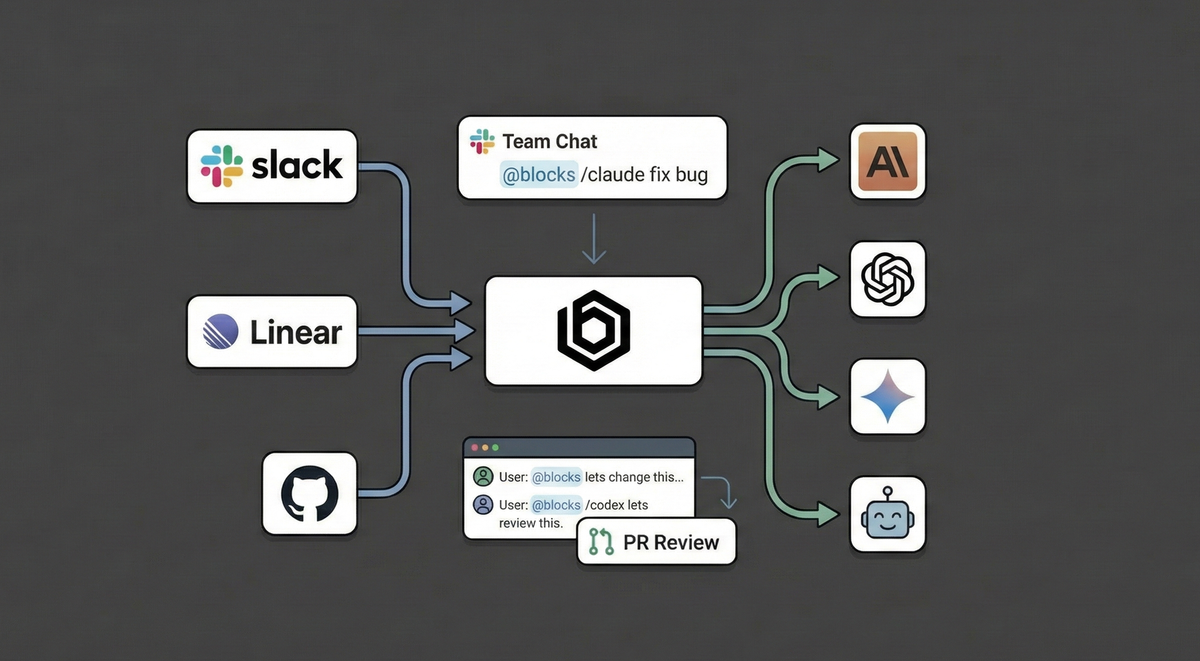
We launched Blocks with a simple thesis: coding agents should work directly from Slack, Linear, and GitHub, the tools teams live in and not require developers to context-switch into yet another interface for simpler coding tasks and mundane ops tasks that an agent with integrations connected can handle.
The best workflows happen where context already exists. When a bug report lands in Slack, your team shouldn't need to copy it to another tool, spin up a terminal, and configure an agent environment. The conversation is the context. The thread is the workspace, which the agent can read and investigate.
That's why we built Blocks to meet teams where they already are.
Beyond Single-Vendor Integrations
Claude Code in Slack lets you @mention an agent to trigger coding sessions. Blocks already does this, but we support Claude Code, Codex, Gemini CLI, and any custom agent your team needs. You can @blocks on Linear, Slack, and GitHub, with more integrations coming soon.
Here's why this matters: different agents excel at different tasks. Your team might prefer Codex for PR reviews, Claude for technical implementation, Gemini for answering PR questions, or a custom agent trained on your internal frameworks. Single-vendor integrations force you to pick one tool for every job.
Blocks is agent-agnostic by design. Install the agents your team actually wants to use, invoke them with simple commands like @blocks /codex or @blocks /claude, and let each one do what it does best.
The Complete Development Lifecycle
While Claude Code's Slack integration focuses on moving from chat to pull request, Blocks enables the complete development lifecycle: from project management (creating enriched Linear issues) to PR changes on GitHub, to ad hoc work on Slack, with the ability to take over agent sessions with our Web VS Code feature.
Here's what that looks like in practice:
In Slack:
@blocks What's been merged this week? Anything affect the status of open Linear tickets?
@blocks Create an issue in Linear for the Order button bug, add technical details from the related codebases
In Linear:
@blocks Break this down into sub-issues
@blocks /codex Resolve this issue
In GitHub:
@blocks /codex Review this PR. Will this affect the frontend?
@blocks Address all the review comments
@blocks Bring up the services with docker compose, seed the DB, and test the endpoints introduced in this PR
And when you need surgical precision? Our Web VS Code integration lets you take over any agent session without disrupting your local development environment. Delegate the routine work, jump in when it matters.
What This Announcement Really Means
Anthropic's move proves the collaboration-first model works. Blocks proves it works even better when you're not locked into a single vendor's ecosystem.
The future isn't about which AI model is smartest, it's about infrastructure that lets teams use any agent, anywhere in their workflow, with true cross-platform context. That infrastructure is what we're building at Blocks.
As TechCrunch noted in their coverage: "differentiation is starting to depend more on integration depth and distribution than model capability alone." We couldn't agree more.
Want to see Blocks in action? Visit blocks.team or reach out to learn how we can help your team delegate engineering work directly from the tools you already use.